Friday, June 6, 2008

RepRap replicates, and Will gets a New Toy

On the left is Adrian Bowyer, the University of Bath professor who started the RepRap project. On the right is Vik Olliver, the most active RepRap builder on the planet. The two machines marked "parent" and "child" are RepRap 3D printers with the interesting relationship that the "child" was mostly built by the "parent". This is a HUGE STEP toward Bowyer's vision wherein RepRaps make more RepRaps and humans benefit. This will do for physical goods what the GPL and Linux and Apache have done for software.

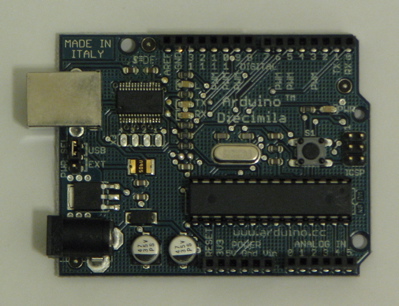
My own news is, at least locally, equally exciting. My CNC mill has finally arrived! And I also got an Arduino controller. I've got my stepper motors from RRRF, and a Harbor Freight router is on the way. It's going to take time to put everything together, and of course there's very little spare time in the life of a modern adult.

Once the CNC mill is up and running, I plan to work on a scheme for swapping out the router and swapping in an extruder for thermoplastic. By that time the RepRap guys will be doing even better than they're doing today, so I will benefit from their stuff. Maybe I'll end up making an actual RepRap before I'm through.

Thursday, May 29, 2008

RepRap: Big step up in print quality!

This posting on the RepRap blog shows the massive progress these guys have made recently in their printing quality. The progression is clearly visible in this photo of some door handles. The most recent incarnation is the work of a guy known as "Nophead", with his own blog describing his work. His machine uses a RepRap extruder on a purchased CNC table rather than the RepRap 3D platform, which made me think that the RepRap platform must be the reason for the less-than-commercial-grade print quality. I asked him about this in a comment, and he replied that the improvements were:
  • his extruder has a shaft encoder to control the speed precisely
  • he has temperature control to +/- 3C
  • he doesn't have any comms delays (I don't know the architecture well enough to know exactly what he means here)
  • he runs his head faster so as to stretch the filament down to 0.5mm.
  • careful choice of printing material
To conclude, he says "All these things can be sorted out on Darwin [the current RepRap prototype] so I expect its prints to be this good in a month or two." That's a very cool thing. It's wonderful to see such progress.

Within just a year or two, RepRap will be much further along in terms of both quality and ease of use, and it will be affordable for small clubs in high schools and colleges all over the world, and large numbers of individual hobbyists. By then it will probably print multiple materials including conductive ones, so you'll be able to embed circuitry in a widget. Today one of the big killer apps for 3D printers is little action figures based on avatars from Second Life and similar games, but when 3D printers really are ubiquitous, people will move on to far more interesting apps that I can hardly imagine.

Let me not forget this very nice list of a lot of different commercial and hobbyist 3D printers.

Still waiting for my CNC mill platform, the eBay fellow has been getting a huge volume of business and his shop is a bit swamped. I've been getting a bit more organized with the electronics, including resuscitating an old FX2 board design, and I've ordered some stepper motor driver parts that should arrive soon.

Wednesday, May 7, 2008

Affordable CNC gadgets

CNC has existed as a hobbyist pursuit much longer than 3D printers have been. I finally broke down and purchased one of these on eBay. It will take a couple weeks to arrive, and the one I got did not include stepper motors, couplers, or motor drive electronics. Those are things I'd enjoy doing myself anyway, so no problem.

I like this project which is along similar lines.

For my own gadget, I need to order stepper motors, think about couplers, and start planning how the electronics will go together. I'm thinking about being lazy and using the parallel port.

I got to see a real RepRap up close!

This evening I went to a presentation and demonstration of a real live RepRap by Bruce Wattendorf and his son. It was very cool to meet somebody who's built a real one and is totally up to speed on every aspect of the project. I asked some questions about the long-term future of the RepRap project.
  • Can they get much better spatial resolution without compromising the social goal of serving the developing world? Yes: better spatial resolutions can be gotten with finer nozzles, which would print slower. You could build a duel-nozzle gadget with a wide nozzle for fast clumsy printing, and a narrow fine nozzle for slow elegant finishing.
  • Will they bump into patent problems as they move toward the state of the art currently occupied by commercial 3D printers? A number of patents will expire in about three years and the RepRap guys will then be much freer in this area.
He wrapped up his presentation by showing the nanofactory video, "Productive Nanosystems: from Molecules to Superproducts". I came to 3D printers from an interest in nanotech, and he came to nanotech from working on 3D printers. It was gratifying to see that the similarity is clear to people on the other side of the fence.

It was a heck of a lot of fun. I took some pictures. Bruce also has many more pictures on his blog. Interestingly, the parts that are normally plastic in a RepRap are made of wood in Bruce's machine, and he's in the process of printing a set of plastic parts.

Bruce's talk was sponsored by a group called DC401, a bunch of Rhode Island folks who enjoy going to DefCon. They are working with a woman in real estate to arrange a lab space in a building in downtown Providence where they can do electronic and mechanical tinkering. It was fascinating to hear her talk about how she's making it all work by using the other floors for businesses and residential space. This reminds me a lot of MITERS, and it warms my heart.

Wednesday, April 23, 2008

RepRap replicates 100%

This story in Computerworld is a couple weeks old, and I should be working harder to keep up. Vik Olliver, a RepRap hacker in New Zealand (and probably the hardest-working RepRap hacker in the world), has now fabricated all the parts of the RepRap except the Z flag, which can be cut out of the side of a beer can. This includes only the parts that it makes sense to print on a RepRap, so it doesn't include stepper motors, nuts and bolts, pieces of metal and wood (e.g. threaded rods). But it's an important step.

I myself am still drooling a bit over some of the hobbyist CNC stuff. There's a guy in New Mexico who sells these things on eBay. He sells aluminum ones (like this) and ones made of MDF, which I believe is a sort of particle board. Many low-end CNC machines are in the $2000 to $5000 ballpark, whereas he sells these in the $300 to $600 ballpark. It should be pretty easy to swap out that orange router and swap in an extruder.

I was thinking a bit last night about how to drive those steppers, since the offerings on eBay don't include the drive electronics. Digikey sells a stepper motor sequencer chip, the L297, which would be used to drive some power MOSFETs. The L297 just needs an input to choose clockwise or counter-clockwise, and a clock pulse to advance a step in that direction, so you need six GPIO lines to control the three motors, and one more to turn on/off the router or squirt goop out of the extruder. There's some very good information on stepper motors and driver circuits here.

It occurs to me that I've never posted the Sourceforge download page for the RepRap design files. A shocking oversight, given that I want to see the project succeed and proliferate.

Thursday, March 6, 2008

Adrian Bowyer interview, Computerworld

Here is the start of the four-page interview. Much of this is stuff that's been published before. Two parts I found interesting appeared on the third page.

Are there plans to modify the current design to replace non-reproducible parts such as bolts with parts that can be manufactured on the machine itself, bringing the overall RepRap design closer to 100 per cent self-reproduction?

Yes - that is definitely one of the evolutionary paths to greater reproductive success. For the immediate future I will be concentrating on widening the list of materials that RepRap can build with (starting with electrical conductors). That widening will implicitly raise the proportion of parts that it can make for itself, of course.

The Fab@Home people have already done a few embedded circuits by printing with conductive silicone. Making circuitry will be a very important ability for these machines.

Can the RepRap recycle what it manufactures?

Yes, recycling has been built in from the start... The main plastic we are using is polylactic acid...

But I want to move to using a non-biodegradable resin. This too is sourced from biomass, but is stable in the ground. That means that the more reprapped goods that get made from it and thrown in landfill, the more carbon is taken out of the atmosphere and locked away for good. And, in 200 years when we have taken so much carbon out of the air to make stuff that anthropogenic global cooling is starting to be a problem, the landfill sites become our strip coal mines to save us.

This is the first time I've ever heard anybody advocate for putting stuff INTO landfills as an environmental measure. An interesting approach to carbon sequestration.

Sunday, March 2, 2008

Coming soon: a complete RepRap kit

BitsFromBytes.com is an on-line store based in the UK which will be offering a complete set of parts for the RepRap for UK£299, or somewhere around US$600 given current exchange rates. They will offer both hardware and software.

I wish I could claim to be so ambitious that I would take a more active approach than simply ordering all the parts in a kit. But I'm as lazy and tired as the next guy, so a kit is really the only practical way I'm likely to do this. And the price is just about right. Months ago, Adrian Bowyer was talking about $400 as a target price for the long term, after lots of self-replicating machines had brought the price of parts down to a minimum. To get so close to the long-term price so quickly is fantastic.

With this kind of head start, the scenario where RepRaps bootstrap themselves to microeconomic ubiquity looks very plausible.