This posting
 on the RepRap blog shows the massive progress these guys have made recently in their printing quality. The progression is clearly visible in this photo of some door handles. The most recent incarnation is
the work of a guy known as "Nophead", with his own
blog describing his work. His machine uses a RepRap extruder on a purchased CNC table rather than the RepRap 3D platform, which made me think that the RepRap platform must be the reason for the less-than-commercial-grade print quality. I asked him about this in a comment, and he replied that the improvements were:
- his extruder has a shaft encoder to control the speed precisely
- he has temperature control to +/- 3C
- he doesn't have any comms delays (I don't know the architecture well enough to know exactly what he means here)
- he runs his head faster so as to stretch the filament down to 0.5mm.
- careful choice of printing material
To conclude, he says "All these things can be sorted out on Darwin [the current RepRap prototype] so I expect its prints to be this good in a month or two." That's a very cool thing. It's wonderful to see such progress.
Within just a year or two, RepRap will be much further along in terms of both quality and ease of use, and it will be affordable for small clubs in high schools and colleges all over the world, and large numbers of individual hobbyists. By then it will probably print multiple materials including conductive ones, so you'll be able to embed circuitry in a widget. Today one of the big killer apps for 3D printers is little action figures based on
avatars from Second Life and similar games, but when 3D printers really are ubiquitous, people will move on to far more interesting apps that I can hardly imagine.
Let me not forget
this very nice list of a lot of different commercial and hobbyist 3D printers.
Still waiting for my CNC mill platform, the eBay fellow has been getting a huge volume of business and his shop is a bit swamped. I've been getting a bit more organized with the electronics, including resuscitating an old
FX2 board design, and I've ordered some stepper motor driver parts that should arrive soon.
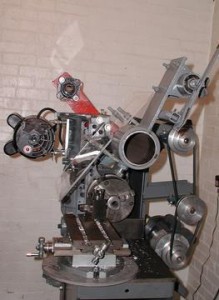 Multimachine, built by Pat Delany of Palestine, Texas, is an inspiring project. It is...
 Frostbot, the work of Brian Schmalz, is another food fabber. It's designed to frost cookies. The CNC mechanism is from Fireball CNC. Brian's other tinkerings include a cool USB bit-whacking board available at Sparkfun.