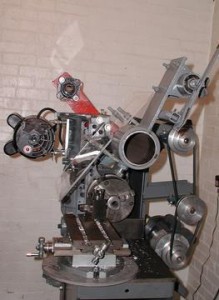
a humanitarian, open source machine tool project for developing countries... The MultiMachine all-purpose machine tool can be built by a semi-skilled mechanic with just common hand tools. For machine construction, electricity can be replaced with "elbow grease" and the necessary material can come from discarded vehicle parts. What can the MultiMachine be used for in developing countries?The project is open source and thoroughly documented. It uses commonly available pieces. It seeks explicitly to address the needs of the developing world. It recognizes the work people did in this area (1, 2) in years past. Cool stuff. We have all kinds of Industrial Revolution era mill buildings in the greater Boston area and this would fit right in.
AGRICULTURE...
WATER SUPPLIES...
FOOD SUPPLIES: Building steel-rolling-and-bending machines for making fuel efficient cook stoves and other cooking equipment...
TRANSPORTATION...
EDUCATION...
JOB CREATION...
Showing posts with label CNC. Show all posts
Tuesday, August 12, 2008
Multimachine
Wednesday, July 2, 2008
Penny wise, pound foolish
I got the idea that I should try to design and build my own electronics. I've done electronics design before, including microcontrollers and FPGAs and the like, but I have little experience with power electronics. That, and I'm impatient. The upshot is that after wasting about three weeks and a few hundred dollars in trying to control stepper motors, I'm not much further ahead. Here is the affordable pre-packaged solution (which had been recommended by the guy who sold me the mechanics) which I should have used from the start:
The mechanics cost about $300 including shipping. The steppers cost $75 (I got them from RRRF). This stepper controller will run maybe $225 with shipping, so the whole thing is $600. That's reasonable. Obviously it doesn't include waste.
I'm thinking it would be fun to fool with Python code that generates G code and sends it to the CNC. I could develop a repertoire of programmatically defined shapes.
- Xylotex three-axis controller with power supply
$205 plus shipping - Xylotex four-axis controller with power supply
$235 plus shipping - Xylotex FAQ
The mechanics cost about $300 including shipping. The steppers cost $75 (I got them from RRRF). This stepper controller will run maybe $225 with shipping, so the whole thing is $600. That's reasonable. Obviously it doesn't include waste.
I'm thinking it would be fun to fool with Python code that generates G code and sends it to the CNC. I could develop a repertoire of programmatically defined shapes.
Friday, June 6, 2008
RepRap replicates, and Will gets a New Toy
Wednesday, May 7, 2008
Affordable CNC gadgets
For my own gadget, I need to order stepper motors, think about couplers, and start planning how the electronics will go together. I'm thinking about being lazy and using the parallel port.
Wednesday, April 23, 2008
RepRap replicates 100%
This story in Computerworld is a couple weeks old, and I should be working harder to keep up. Vik Olliver, a RepRap hacker in New Zealand (and probably the hardest-working RepRap hacker in the world), has now fabricated all the parts of the RepRap except the Z flag, which can be cut out of the side of a beer can. This includes only the parts that it makes sense to print on a RepRap, so it doesn't include stepper motors, nuts and bolts, pieces of metal and wood (e.g. threaded rods). But it's an important step.I was thinking a bit last night about how to drive those steppers, since the offerings on eBay don't include the drive electronics. Digikey sells a stepper motor sequencer chip, the L297, which would be used to drive some power MOSFETs. The L297 just needs an input to choose clockwise or counter-clockwise, and a clock pulse to advance a step in that direction, so you need six GPIO lines to control the three motors, and one more to turn on/off the router or squirt goop out of the extruder. There's some very good information on stepper motors and driver circuits here.
It occurs to me that I've never posted the Sourceforge download page for the RepRap design files. A shocking oversight, given that I want to see the project succeed and proliferate.
Thursday, February 28, 2008
More service bureaus
In a couple of recent postings I have talked about the Ponoko laser-cutting service. Another very interesting online service bureau is Emachineshop.com which is a machine shop to which you send design files created with their downloadable CAD software. They have some examples of the things people have made. Just poking around their website really makes me drool a little bit. I can't believe I'm not doing something with this.
Big Blue Saw is a service bureau that does waterjet cutting of metal and plastic. They cut very thick pieces of metal, which surprises me, I didn't know you could do that.
A couple more: Fabjectory.com specializes primarily in making physical copies of avatars from games like SecondLife. FluidForms makes pretty flowing shapes for things like vases and pitchers. I haven't read about these yet, and as of this writing I don't know what technology they use, or what design software.
Big Blue Saw is a service bureau that does waterjet cutting of metal and plastic. They cut very thick pieces of metal, which surprises me, I didn't know you could do that.
A couple more: Fabjectory.com specializes primarily in making physical copies of avatars from games like SecondLife. FluidForms makes pretty flowing shapes for things like vases and pitchers. I haven't read about these yet, and as of this writing I don't know what technology they use, or what design software.
Broadening the definition of "fabber"
I want to broaden the scope of this blog a bit. The word "fabber" is generally accepted as synonymous with "3D printer" but a 3D printer has a lot in common with both CNC machines (routers for wood or milling machines for metal) and laser cutters. There are hobbyists building all of these. All of them make a 2D or 3D shape under computer control with relatively little human intervention, and minimal need for human skill.How many of these gadgets could be self-replicative in the RepRap sense? For example, could one use a laser cutter
(or a laser-cutting service like Ponoko) to cut out pieces and use those pieces to build another laser cutter, thereby driving down the cost of laser cutters? As with RepRap there will inevitably be complicated pieces that can't be made that way. CO2 lasers are dangerous and expensive, so I don't think this could make the kind of impact in the developing world that RepRap hopes to make. A replicating CNC machine might be a better bet, as Dremel tools are much cheaper and safer than lasers.That self-replicative idea does fascinate me a good deal. It will, over time, drive down the price of the self-replicating thing. That doesn't mean we'll enter a microeconomic paradise, but it promises at least to be interesting and possibly to raise the quality of life noticeably.
I've haven't blogged too much about commercial machines. I want to do more of that. I admire the hobbyists and their perseverance in the face of difficulties, but the technology appearing in commercial machines will gradually trickle down into the hobbyist arena as patents expire.
Friday, February 15, 2008
An XYZ platform for fabbing or CNC
My hope is that the blue-hatched stage can be made to take either a Dremel tool for CNC milling, or an extruder for fabbing. The result might or might not be self-replicative in a RepRap sense but it would be a cool toy.
Wednesday, February 6, 2008
Interesting Russian project
Here's the website in Russian, and a Google translation to English (click on the "Constructor Kulibin" link). I found this referenced from MAKE Magazine. This is a very interesting project.
They have a great-looking XYZ stage built from a CNC kit. They lower a heating element onto powdered raw material, sintering the raw material as the CandyFab does, except their heating element is a length of nichrome wire instead of a jet of hot air. It gets hot enough to glow, and on the web page they mention that they can work with any powdered material with a melting temperature from 100 to 300 Celsius, including sugar, wax, "Plexi" (plexiglass?), and mixtures such as plastic and sand, plastic and metal powder, powdered paint and sugar powder. Like the CandyFab, each layer of fresh material is laid down on top of the previously worked layer (and I hope that process is automatic as it sounds tedious otherwise) and then you scribble a cross-section on the new layer with the heating element, and then it's time to put down another layer.
The nice thing to this kind of approach is that the unmelted/unfused material provides mechanical support for the built structure. You can build shapes that RepRap and Fab@Home can't make, such as bridges or inverted cones, because any bridge-like part that will go over empty space is built with stuff under it to support it.
This made me curious to start looking around at CNC kits, which could nicely jump-start any fabber project. The XYZ machinery for a fabber is called a "gantry" in CNC language, and there is a very active hobbyist CNC community. Here is a video for a CNC gantry kit that somebody was selling for $195 on eBay. The video itself is for sale ($20) so this is just a teaser.
Here's a few interesting CNC links.
Subscribe to:
Posts (Atom)